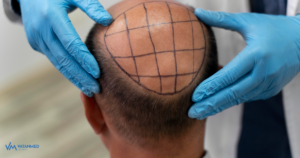
How Many Grafts Are Needed for Hair Transplant? Hairline, Crown and Larger Areas
How many grafts are needed for hair transplant is one of the most common questions asked by patients planning a procedure in Poland. This especially applies to people from the United Kingdom, Ireland, Germany, Scandinavia and other European countries who compare clinics, methods and the expected number of grafts before travelling for treatment.
However, it is important to know that there is no single universal number of grafts suitable for every patient. The number of grafts depends on the degree of hair loss, quality of the donor area, hair thickness, expected density, patient age, type of hair loss and selected technique. A consultation with a qualified specialist is important, because the best method depends on the individual case.
If you are wondering how many grafts are needed for hair transplant, the answer must always be based on an individual assessment. The same number of grafts may give different visual results in two different patients because hair quality, scalp contrast and donor area capacity are not the same.
If you are considering a hair transplant in Poland, this guide will help you understand what grafts are, how their number is estimated and what popular terms such as 3000 grafts hair transplant or 4000 grafts hair transplant mean.
How Many Grafts Are Needed for Hair Transplant?
The answer to the question how many grafts are needed for hair transplant depends on the individual assessment of the patient. For one person, a relatively small number of grafts may be enough to correct receding temples, while another patient may need a larger procedure covering the hairline, mid-scalp and crown.
In practice, approximate ranges may look as follows:
- small hairline correction: around 800–1500 grafts,
- receding temples and frontal hairline: around 1500–2500 grafts,
- larger thinning in the front of the head: around 2500–3500 grafts,
- crown area: around 1500–3000 grafts,
- extensive hair loss: around 3500–5000 grafts or more, depending on donor area capacity.
These are only approximate numbers. The final number of grafts for hair transplant should be determined after photo analysis, consultation, donor area assessment and realistic result planning.
Patients often ask how many grafts are needed for hair transplant because they want to estimate the cost and the expected effect before travelling. This is understandable, but the final plan should always protect the donor area and support a natural-looking result.
According to NHS hair loss information, hair loss can have many causes, including genetics, disease, stress, medications or hormonal changes. Therefore, qualification for a hair transplant should consider not only the current appearance of the hair, but also the possible development of hair loss in the future.
What Are Grafts in Hair Transplant?
Hair transplant grafts are follicular units taken from the donor area and transferred to places where the hair is thinning or not growing. One graft does not always mean one hair. A single graft may contain one, two, three or sometimes more hairs.
This means that a patient who receives 3000 grafts may receive more than 3000 individual hairs. The exact number of hairs depends on the patient’s natural follicular unit structure.
Understanding grafts is important when asking how many grafts are needed for hair transplant. The number of grafts is not the same as the number of hairs, and the visual effect depends on how those grafts are selected, placed and distributed.
During procedure planning, the specialist takes into account:
- the number of available grafts in the donor area,
- the number of hairs in individual grafts,
- hair thickness and colour,
- contrast between hair and skin,
- hair growth direction,
- the area requiring thickening,
- the patient’s expectations.
For this reason, two people with a similar degree of hair loss may need a different number of grafts to achieve a natural and proportional result.
How Many Grafts for Receding Temples?
How many grafts for receding temples are needed? In the case of receding temples, the number of grafts depends on the depth of hairline recession, forehead shape, patient age and how low the new hairline should be designed.
Approximate ranges are:
- mild receding temples: around 800–1500 grafts,
- moderate receding temples: around 1500–2200 grafts,
- larger frontal hairline reconstruction: around 2200–3000 grafts.
When patients ask how many grafts are needed for hair transplant in the hairline area, the answer should include not only graft quantity but also hairline design. The frontal hairline is highly visible, so natural direction, angle and density are very important.
Hairline design requires caution. A hairline that is too low or too dense may look unnatural, especially in younger patients whose hair loss may still progress. A good plan should consider both current appearance and future hair loss development.
With the FUE hair transplant method, individual follicular units are extracted from the donor area and placed in a way that allows a natural hair growth direction. In the case of receding temples, precision is especially important because the frontal hairline is very visible.
How Many Grafts for the Crown?
How many grafts for the crown are needed? The crown often requires an individual approach because hair in this area grows in a spiral pattern, and achieving visual density may require careful graft placement.
Approximate ranges for the crown are:
- small crown thinning: around 1000–1800 grafts,
- moderate thinning: around 1800–2500 grafts,
- larger crown area: around 2500–3500 grafts or more.
The crown can be more demanding than receding temples because a large circular thinning area may “absorb” many grafts. In patients with a limited donor area, the specialist may suggest prioritising density in the frontal part of the head because it often has a greater impact on facial appearance.
If the main question is how many grafts are needed for hair transplant in the crown, the answer depends strongly on the size of the thinning area and the patient’s donor area. Crown restoration should be planned carefully to avoid using too many grafts too early.
Results may vary depending on the patient. In one person, 2000 grafts in the crown may provide satisfying optical improvement, while in another patient this number may be insufficient due to thin hair, a large bald area or high contrast between the skin and hair.
3000 Grafts Hair Transplant – When Can This Number Be Used?
3000 grafts hair transplant is a common range for moderate hair loss. This number may be considered, for example, for rebuilding the hairline and thickening the front of the head, or for combining a smaller frontal correction with partial thickening of the mid-scalp.
Patients often ask how many grafts are needed for hair transplant when they see examples of 3000 grafts online. This number can be useful in many cases, but it should never be treated as a universal solution.
3000 grafts may be used in cases of:
- larger receding temples,
- frontal hairline reconstruction,
- moderate thinning in the front of the head,
- partial thickening of the mid-scalp,
- selected crown cases if the area is not very large.
However, this does not mean that 3000 grafts will be appropriate for every patient. It is important to maintain a balance between expected density and donor area safety. Excessive graft extraction may worsen the appearance of the donor area, so the plan should be reasonable and long term.
4000 Grafts Hair Transplant – Who Is It For?
4000 grafts hair transplant may be considered in more advanced hair loss if the donor area allows safe extraction of this number of follicular units. It may include larger reconstruction of the frontal area, mid-scalp or a selected combination of several zones.
When evaluating how many grafts are needed for hair transplant, 4000 grafts may sound attractive because it is a larger number. However, more grafts should only be used when the donor area can safely support such extraction.
4000 grafts may be needed when the patient has:
- significant hairline recession,
- a large thinning area,
- a combination of receding temples and mid-scalp thinning,
- partial crown and frontal hair loss,
- good quality and sufficient density in the donor area.
It is important not to treat a higher number of grafts as automatically better. In hair transplantation, not only quantity matters, but also placement, implantation direction, hairline planning, graft quality and safe extraction.
NHS hair transplant information emphasises that the patient should make sure the procedure is performed by an appropriately qualified and experienced specialist and that they understand the possible risks, costs and recovery process.
What Affects the Number of Grafts in a Hair Transplant?
The number of grafts for hair transplant depends on many factors. The degree of hair loss alone is not enough for accurate planning. The specialist must assess the patient’s full situation.
To answer how many grafts are needed for hair transplant, the clinic should consider the size of the thinning area, donor area capacity, hair characteristics, future hair loss risk and the patient’s realistic expectations.
Degree of Hair Loss
The larger the area requiring thickening, the more grafts may be needed. However, in very extensive hair loss, it is not always possible to cover the entire scalp with high density during one procedure.
Quality of the Donor Area
The donor area has a limited number of grafts. Safe planning means extracting the right number of follicular units without excessively weakening the appearance of the back and sides of the head.
Hair Thickness and Colour
Thicker hair may provide better visual coverage than very fine hair. Lower contrast between hair colour and skin colour may also improve the appearance of density.
Procedure Technique
Methods such as FUE and DHI hair transplant differ in how hair is extracted and implanted. The best method depends on the individual case, so technique selection should result from consultation, not only from marketing preference.
Realistic Expectations
The patient should know that a hair transplant improves density and appearance, but it may not always restore the same density as in the teenage years. A responsible clinic should help set a realistic goal.
Does More Grafts Always Mean a Better Result?
No. A higher number of grafts does not always mean a better or more natural result. Overly aggressive extraction may strain the donor area, while overly dense implantation in the wrong place may look unnatural or may not be optimal from a long-term planning perspective.
This is why the question how many grafts are needed for hair transplant should not be answered only with the highest possible number. A safe and natural plan is usually more important than using as many grafts as possible.
A good result depends on:
- proper patient qualification,
- safe graft extraction,
- natural hairline design,
- appropriate distribution of follicular units,
- team experience,
- a realistic plan for the future,
- proper aftercare.
Information about standards and education in hair restoration surgery can be found on the website of the International Society of Hair Restoration Surgery. Additionally, publications available in the PubMed medical research database show that hair transplantation requires proper technique, patient qualification and planning.
What Does Consultation and Graft Estimation Look Like?
During consultation, the specialist analyses photos or performs an on-site scalp assessment. The patient should provide information about the duration of hair loss, diseases, medications, previous procedures and expectations.
Consultation is the best moment to ask how many grafts are needed for hair transplant in your specific case. It also helps determine whether the planned number of grafts is realistic and safe for the donor area.
Consultation may include:
- assessment of the type of hair loss,
- analysis of the donor area,
- hairline design,
- estimated number of grafts,
- discussion of the FUE or DHI method,
- recovery plan,
- information about possible limitations.
The Cleveland Clinic hair loss overview indicates that hair loss may be temporary or permanent and may result from many different factors. For this reason, assessing the cause of hair loss is important before choosing treatment.
Why Do Patients from Europe Ask About Graft Numbers Before Coming to Poland?
International patients often want to know the approximate number of grafts before travelling. This is understandable because it helps better plan the budget, length of stay, procedure scope and expectations.
For patients from abroad, the question how many grafts are needed for hair transplant is also practical. It helps them understand whether the treatment may involve a small hairline correction, crown thickening or a larger reconstruction.
People from the United Kingdom, Ireland, Germany, Norway, Sweden, Denmark or the Netherlands often send photos for an initial online consultation. Based on this, the clinic can estimate the scope of the procedure, but the exact decision may require an in-person assessment.
Vatanmed Poland provides information for patients considering a hair transplant in Poland. Consultation helps determine whether the patient needs receding temple correction, crown thickening, larger hairline reconstruction or another treatment plan.
FAQ Section
How many grafts are needed for hair transplant?
How many grafts are needed for hair transplant? It depends on the degree of hair loss, donor area, hair thickness, expected density and selected method. Small corrections may require around 800–1500 grafts, while larger procedures may require 3000–4000 grafts or more.
How many grafts for receding temples are usually needed?
How many grafts for receding temples are needed? Mild receding temples may require around 800–1500 grafts, moderate cases 1500–2200 grafts, and larger hairline reconstruction around 2200–3000 grafts. The final number depends on individual assessment.
How many grafts for the crown are needed?
How many grafts for the crown are needed? Small thinning may require around 1000–1800 grafts, moderate thinning around 1800–2500, and a larger crown area 2500–3500 grafts or more. The crown often requires careful planning due to the spiral direction of hair growth.
Does a 3000 grafts hair transplant give a good result?
3000 grafts hair transplant may provide visible improvement in many patients with moderate hair loss, especially in the frontal area. However, the result depends on hair quality, donor area, graft distribution and patient expectations.
Is 4000 grafts hair transplant a lot?
4000 grafts hair transplant is a larger procedure range that may be used in more advanced hair loss. Not every patient can safely donate this number of grafts, so donor area assessment is necessary.
Does more grafts always mean a better result?
No. More grafts do not always mean a better result. Proper qualification, safe extraction, natural hairline design, graft quality and a realistic treatment plan are more important. Results may vary depending on the patient.
How many grafts are needed for hair transplant in larger areas?
How many grafts are needed for hair transplant in larger areas depends on the size of the thinning zone, donor area capacity and expected density. Larger areas may require 3500–5000 grafts or more, but safe donor management is essential.
Conclusion
How many grafts are needed for hair transplant? There is no single answer for all patients. Receding temple correction may require around 1500–2500 grafts, the crown often 1500–3000 grafts, and larger bald areas 3000–4000 grafts or more. The final number depends on the type of hair loss, quality of the donor area, hair thickness, expectations and selected method.
When deciding how many grafts are needed for hair transplant, safety and long-term planning are just as important as density. A responsible plan should protect the donor area while creating a natural improvement.
A consultation with a qualified specialist is important because only individual analysis can determine a safe and realistic number of grafts. The best method depends on the individual case, and results may vary depending on the patient.
If you are considering a hair transplant in Poland and want to know how many grafts may be needed in your case, contact Vatanmed.pl and book a consultation to discuss your treatment plan, method and expected procedure scope.
Contact and Locations – VatanMed Poland
Phone / WhatsApp: +48 570 900 613
Email: info@vatanmed.pl
Website: https://vatanmed.pl
Warsaw
ul. Rolna 179
warszawa@vatanmed.com
+48 570 766 533
Wrocław
ul. Powstańców Śląskich 123
wroclaw@vatanmed.com
+48 537 060 336
Kraków
ul. Okulickiego 51
krakow@vatanmed.com
+48 570 766 443
Gdynia
ul. Legionów 116
gdynia@vatanmed.com
+48 570 766 170
Opening Hours
Monday – Friday: 09:00 – 17:00
Saturday: 09:00 – 14:00
Sunday: closed
Medical Disclaimer
This article is educational and informational. It does not replace a medical consultation or individual qualification for the procedure. The final price, method and possibility of performing a hair transplant should be determined after the case has been analysed by a specialist.
Last updated: 2026
 Polish